Sustainable Maritime Fuels
Clean fuels for trade, travel, commerce, and job creation
The Sustainable Maritime Fuels Collaborative aims to accelerate the availability, affordability, and deployment of sustainable maritime fuels and low and zero emission vessels and technologies in the Pacific Northwest through a lens of equitable prosperity towards net zero emissions by 2050.
The Value
Washington’s maritime industry must prepare to be able to shift to new low and zero carbon fuels to remain globally competitive, confront climate change, and advance environmental justice. Proposed international targets on shipping emissions, increasing customer expectations, and improving the health of our communities are key drivers. Our state’s history of leadership in clean energy and technology, research and development, and maritime innovation affords a unique capacity for economic and innovation development.
The Need
- The Pacific Northwest is a maritime fueling hub for a range of vessel types essential to trade, tourism, and commerce.
- Washington’s maritime industry generates over $45.9 billion in total revenue, supports 174,300 jobs and $14.4 billion in labor income.
- In 2019, international bunker fuels sold in Washington resulted in approximately 6.8 million metric tons of greenhouse gas emissions, an amount equivalent to 16% of total Washington transportation sector emissions.
- In 2019, an estimated 538 million gallons of maritime fuels were supplied in Washington.
- Pollution from fossil maritime fuels like diesel, heavy fuel oil, and marine gas oil is concentrated around ports and contributes to health disparities in near-port communities which rank among the highest in diesel pollution and disproportionate impact by the Washington Department of Health’s Environmental Health Disparities Map
The SMF Collaborative
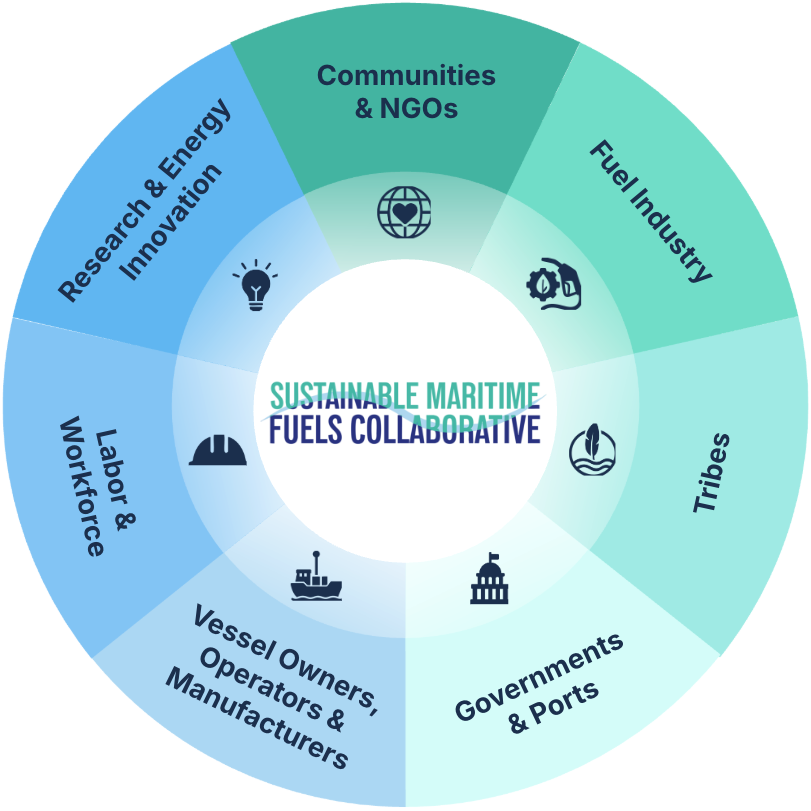
The SMF Collaborative will convene representatives from across the maritime fuel and use value chain through working groups, workshops, studies and more with the following priorities:
- Conduct gaps analyses to identify impediments or primary challenges to accelerating deployment of SMFs (sustainable maritime fuels) in the Pacific Northwest (PNW);
- Advance policy developments that support accelerated availability and use of SMFs;
- Support meaningful engagement with adjacent and impacted communities;
- Identify types of definitions and standards that would assist state and local governments in supporting deployment of SMFs in the PNW;
- Identify research opportunities through early-stage technology gaps and foster innovation pathways;
- Support demonstration projects that foster innovation from research through commercialization;
- Drive practical deployment and adoption of SMFs; and
- Support workforce pathways and opportunities in the maritime clean energy transition.
To learn more please contact
Collaboration in Action
October 2025
Maritime Blue hosted the SMF & Maritime Decarbonization Forum at One Ocean Week Seattle, bringing together more than 100 individuals from across industry, nonprofits, governments, and more to connect and spotlight the Pacific Northwest’s leadership in maritime decarbonization and future fuels.
June 2025
Maritime Blue delivered a Sustainable Maritime Fuels Framework for the Washington Department of Commerce and Washington State Legislature.
April 2025
With support from partners, Maritime Blue launched the Sustainable Maritime Fuels Collaborative to formally convene partners from across the region to accelerate the availability, affordability, and deployment of sustainable maritime fuels and low and zero-emission vessels and technology in the Pacific Northwest.
August 2024
RMI‘s Advancing Zero-Emission Fuels in Washington’s Shipping Sector Roadmap was published. The study provides a regionally focused roadmap for decarbonizing Washington State’s shipping sector, offering insights for policymakers, industry leaders, and other stakeholders. The study identifies demand-side pathways for deploying Zero Emissions Fuels (ZEFs) by 2030 and for fully decarbonizing maritime fuels at Washington ports by 2050. It then assesses the feasibility of hydrogen and biofuel-based ZEFs through techno-economic analysis, focusing on emissions, cost, scalability, and technology. Finally, it analyzes policy options to support ZEF production and use.
December 2023 - June 2024
Sustainable Marine Fuels Roadmap study partners convened two workshops with over 90 representatives from maritime, fuel, technology, environmental, research, state and federal agencies, and others to provide input into the fuel pathway study, related supply constraints, proposed policy recommendations
October 2023
The PNW Hydrogen Association (PNWH2) Hub was awarded a DOE Hydrogen Hub award to develop and bring to market clean hydrogen power solutions. H2 is a key input for maritime fuel and a fuel for port infrastructure, so large-scale H2 production along with the adoption of new technologies is crucial to reach decarbonization goals.
October 2023
Washington Maritime Blue, the Port of Seattle, and the Pacific Northwest National Lab led an “author’s convening” bringing together national labs, Washington Department of Commerce, the U.S. Department of Energy, the Maersk McKinney Moeller Center for Zero Carbon Shipping, RMI, the Northwest Seaport Alliance, and other experts to share and coordinate maritime decarbonization studies underway in the Pacific Northwest.
September 2023
Non-profit Rocky Mountain Institute (RMI), with funding from Breakthrough Energy, in collaboration with founding partners and the Washington State Department of Commerce launched a Sustainable Marine Fuels Roadmap study to assess the maritime fuels landscape and pathways for zero emissions fuel supply in the Pacific Northwest.
Additional Information
This activity is partially supported with funding from Washington’s Climate Commitment Act. The CCA supports Washington’s climate action efforts by putting cap-and-invest dollars to work reducing climate pollution, creating jobs, and improving public health. Information about the CCA is available at www.climate.wa.gov.